Thursday, 2 November 2023

Poetry for All (#PfAFundraiser23)

Some personal anecdotes and a plea follow...

As quite a few of you know, I’ve been engaged in disability awareness and rights campaigning and other work since sometime in the 90s, so when I was given an opportunity to support and host an event dedicated to making performance poetry as accessible as possible in 2018, I jumped on it.

On an orange background, which fades to a soft, white glow in the centre, are the words "Poetry For ALL" in a dark purple font. On either side of the words are impressionistic line art of hands which overlap as though gesturing rapidly in a flapping motion, also in dark purple.
Logo designed by Fay Roberts, 2022

Poetry for All is the brainchild (and heartchild, and soulchild) of Rose Drew, who I first met through one of Richard Tyrone Jones’s Utter events in London. She’s an extraordinary writer and performer, and a powerhouse of an events host and organiser. Within about 30 seconds of watching her on stage, I knew I wanted to be like her when I grew up as an artist. When she got in touch three years later to ask if I’d like to help out with what turned out to be the inaugural event, I threw myself into providing as much support as possible with enthusiastic abandon, and we pulled together a line-up which included the extraordinary performers Raymond Antrobus and DL Williams (“DeafFirefly”), both of whom I’d performed with before and was keen to see again. 

Now, there’s a whole section on our new website about the history of the events where you can read the facts, but I want to say here that, personally, that first event in March 2018 (coincidentally on my birthday!) was an absolute eye-opener – seeing how poetry events could expand and develop the ideal of accessibility in ways I hadn’t considered. It was also extremely inspirational as I realised that, well, I was allowed to write about my disabilities. Seeing and hearing artist after artist sharing so much and so eloquently unlocked something in me that I didn’t even know I’d been repressing:

I’m allowed to be an openly disabled poet. I’m allowed to express my neurodivergence. I can tell my truth. 😱🤯

Bit of a culture-shock, but I owe so much to the poets and to Rose (and to Dave Wycherley, BSL interpreter extraordinaire – that’s a hard and physically/ mentally taxing job as it is, but to do that with poetry? on the fly?! breathtaking...) for helping me get to that starting point, knocking down the walls of my own internalised ableism.

So, apart from a paean to self-expression and why representation and finding tribe matters, and a screed of gratitude for new friends made and old friendships strengthened through the course of these events, why am I writing this? What’s with the hashtag? “Plea...?”

Well, so far, since you ask, all of our events have had local funding in York, where they’ve taken place exclusively so far. Rose applied for Arts Council England funding for this and next year for a tour comprising several venues and a host more disabled artists and BSL interpreters from various parts of the UK (all getting paid properly!), but we found out last week that we’d not got the money. Any of it. So our forthcoming event on 24th November in the gorgeous National Centre for Early Music is in jeopardy and, since the thought of Rose (herself a disabled artist on low wages) having to pay for this out of her own pocket was not to be supported, I threw myself at a plan of creating a (somewhat last-minute) Crowdfunder, so that we can at least pay for the venue, the artists’ and interpreters’ fees, the travel and accommodation expenses of those of us coming from out of town, and the costs of producing merchandise to sell. We’ll be producing an anthology in print and ebook form, as a joint publication between indie publishers Stairwell Books and Allographic Press. And, if we exceed our funding goal, there’ll be video and audio available of the event to boot!

We’ve created a frankly very exciting range of pledge rewards for people wanting to support us (all the way from £1 and £2 options, since money is tight, especially for disabled folk, right now, to more chunky ones like private mentoring, workshops, and a publishing package), and we’ve got three weeks(!) to raise our £1,500 to cover the shortfall from ticket and merch sales. Eeep! So, if you’re able to and would like to help us, we’d be ever so grateful. The campaign is here:

https://www.crowdfunder.co.uk/p/poetry-for-all-2023-fundraiser

And if you have absolutely no funds to share with us at all, we’d be incredibly grateful if you shared on social media, with friends, on blogs, all of that!

Thanks for reading all this, and have a great day!

Thursday, 26 October 2023

It's Finally Here…

I’ve been beavering away at this for a few days, committing to putting together a proper website at last, using the template the brilliant Hannah Chutzpah put together for me ages ago as a basis and then going ham. And I’ve done it! There’s an actual website with my name on it and you can find out all sorts of things about what I do right here: http://www.fayroberts.co.uk

I have not yet added in any of the info I need to about being a storyteller, or a musician, or someone who draws stuff too, but I figured that I’ve delayed putting this out there long enough, and better done than perfect, as they say… I can always add those other bits later.

Please let me know your thoughts. Are there other things you’d like to see? How easy is it to navigate? Should I ditch the colour scheme in favour of something a bit more conventional? (Not all the images have image descriptions yet, but I’m working on it!)

Tuesday, 22 November 2022

Self-Promo!

(Or: I made an ebook of Spectral, the “concept album but it’s poetry” book I produced, published by Burning Eye Books earlier this year, and I should actually tell people about it...)

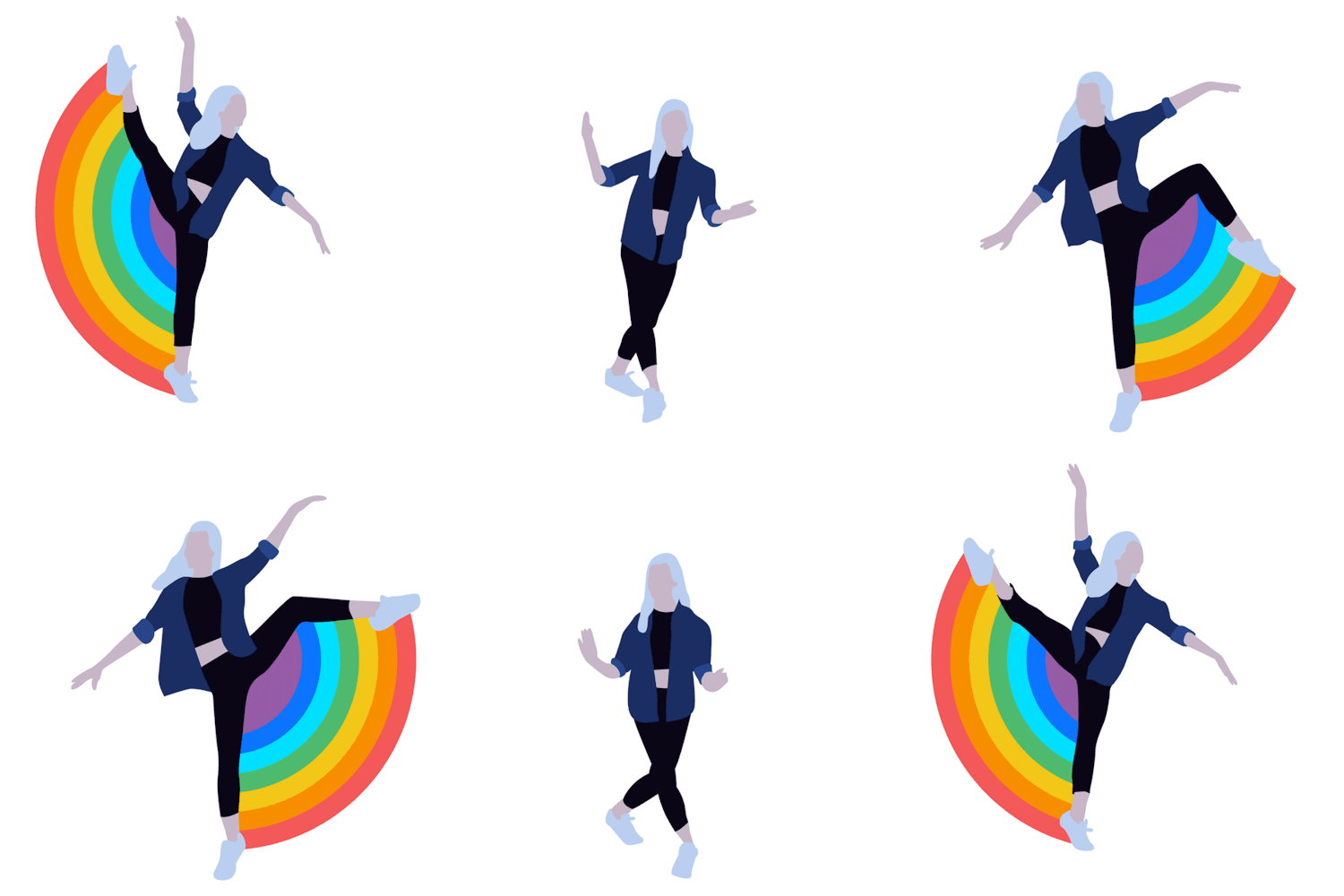
a cartoon of a pale, faceless person with long, white hair in black crop-top and trousers, alternately flinging their left and right foot high above their head. An arc of rainbow follows the path of their leg each time.

All content is almost exactly the same as the paperback (except where I explicitly talk about it being an ebook); the QR codes are interactive links straight from the interface; all the images (yes, including every content warning symbol) have relevant image descriptions; and my accidental test user seems delighted at the functionality (I think she quite liked the poems as well!), so I should probably tell y’all where to get hold of one!

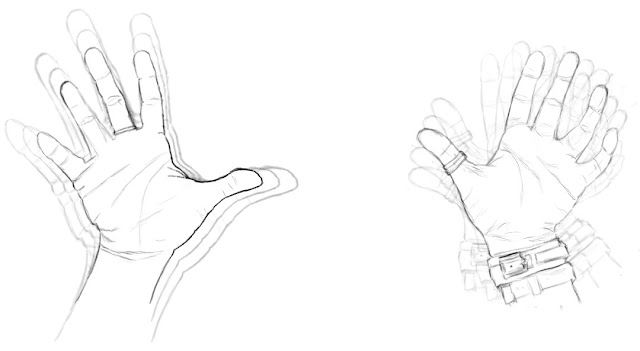
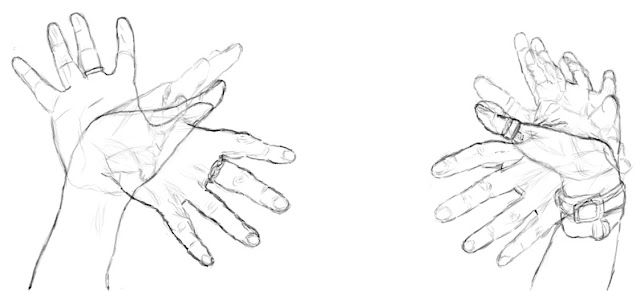
Digital sketch of a pair of hands and a small amount of forearm. There are three sets of overlapping outlines with spread fingers - one with fingers pointing up and somewhat back, one with fingers slanting downward, one, fainter, somewhere between those two positions. The fingers are somewhat lined and wearing rings on middle finger (left hand) and thumb (right hand), with a double band of some kind, complete with buckles, just below the wrist of the right.

It’ll be out on Kindle, Kobo, Apple Books, B&N, etc. soon, but for now you can order an ePub file direct from Lulu, the distributor, here. (Also I get a bigger chunk of the money, if I’m brutally honest.)

And yes, the audiobook is on its way (audio editing remains my slowest skill).

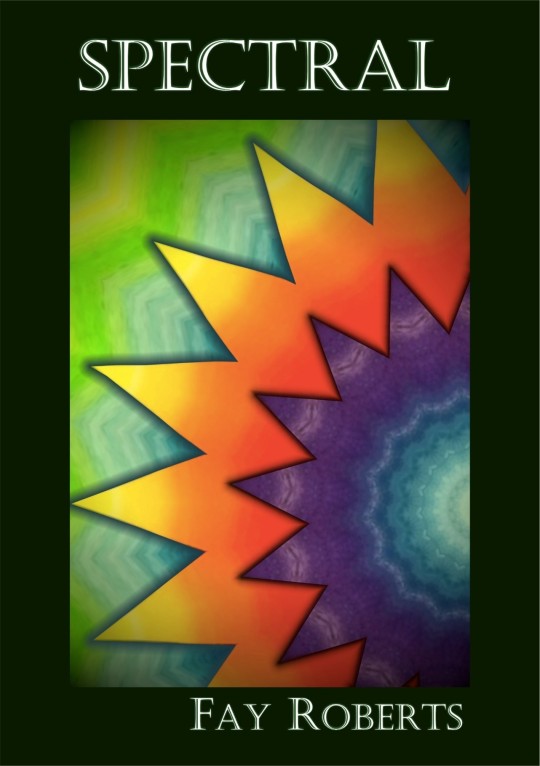
Inside a very dark green border is a series of jagged circles of different colours. The whole implies a mandala, or a rather geometrically exact flower against a patterned, greenish background. The outer "petals" are yellow shading through orange to red, with triangular points at either end of this spectrum, outlined in black to give an impression of depth through shadow. The inner stamens are shades of very light aqua and teal in the centre, in a series of quite subtle, tiny waves, moving outward to a textured purple. At the top of the image is the word 'SPECTRAL' and at the bottom the name 'Fay Roberts'

Okay, I’m going to shuffle away, feeling slightly awkward now, because telling people I’ve made something I’m proud of always does this...

Thursday, 17 March 2022

Whimsical Pantomimes

The final section in the Spectral Poetry Book is Whimsy. More than straight-up funny, whimsy is surrealism, arbitrariness, and contrariness. At least, it is in my book. Literally. Huh. Okay, anyway, like many British people, my first exposures to Proper Poetry were all humorous, surreal, often dark, sometimes salutary. Edward Lear and Lewis Carroll, Pam Ayres, Liz Lochhead, Roger McGough, John Hegley, and, almost certainly formatively at such a young age, Hilaire Belloc (in my parents’ defence, I rarely slam doors, don’t chew string, and haven’t waved a gun at family members, so: lesson learned?). Some of my favourite performance poets excel at humour, and there’s something wonderful about sharing laughter in a poetry space, especially since we also use it for the catharsis, previously discussed, of the bad and scary and difficult.

And, while the discovery that comic poetry isn’t my main strength and that that doesn’t matter was a real turning point (and I can remember exactly where I was when I had this revelation, and I can tell you that being halfway through performing a poem is an odd place for a pivotal personal realisation), I still indulge in writing odd flights of fancy. And sometimes even sharing them with people! And maybe I shouldn’t be so quick to say that comic performance is something that other folk do, much to my delight and relief... I once won a competition to be the worst poet in the room, though, in fairness, the man who apparently literally injured himself laughing at the line about gluten-free breadcrumbs is better now.

Appropriately enough, this section is the least autobiographical of them, with half of the pieces being closer to microfiction (with rhymes) than anything else Most of them are short and all of them are pretty snacky. And I found myself relishing the opportunity to just throw some real silliness around and not worry about whether they were good enough. (We should probably all consider ourselves lucky that it isn’t 20 pages of clerihews, quite frankly!)

The section is started and represented by these hands here:

Digital sketch of a pair of hands, fingers up and splayed, palms facing the viewer, both canted slightly to either side with the thumb sticking out. The left wears a ring around its middle finger. The right wears a double ring around the thumb, and a pair of buckled straps just below the wrist. The left hand has two further, translucent versions of itself, each progressively larger than the first, behind it. The right has four translucent versions of itself, each rotated slightly further out of true - two in either direction - behind it.

My main challenge was finding a static pose for such a dynamic and unpredictable notion. But imagine a head between the two hands, tongue sticking out, and hopefully you get the inspiration. Another challenge was learning enough about the software to allow me to perpetrate this. Yet again, it’s imperfect, but I’ve both completed the task and learned a bunch of interesting things, so it feels like a win.

At the time of writing this, it’s early January. By the time you see this, we’ll have a week to go before the current, official launch date. Good luck, Future Fay – you’ve got this!

Thursday, 10 March 2022

Philosophical Shrugs

The next section in the Spectral Poetry Book is Philosophy & Mysticism. And oh boy is this a difficult one to define! But then, when asked “What kind of poetry do you do, then?” I’ve struggled with that definition as well, so this section is for all the stuff about which I tend to shrug and say: “I guess it’s a bit... metaphysical? metaphorical? meta-something, anyway. Um…” And I know I’m not alone – plenty of poets out there getting to grips with the form beyond forms, or attempting to pin the liminal to the printed page. You might say.

Okay, fine, this section’s potentially a touch pretentious in places, okay? Good, we addressed the horse in the corner. This is the section for me to revel in the mythological stuff I love to play with, along with streams of consciousness and the more dream-like musings that I try not to indulge in too often. It ends with some puns that are incredibly obscure, even for me, with perfect timing for the next section...

The section is started and represented by these hands here:

Digital sketch of two pairs of the same hands. In one pairing, the right hand is cupping the elbow of the left, which is gesturing as if in mid-flow of expounding an idea. The left hand has a ring with vaguely outlined Celtic knotwork on it around the middle finger. The right hand has a plain pair of rings about the thumb and a pair of buckled bands just below the wrist. In the other pairing, which sits in the middle of the L-shape created by the first pairing. the left hand is upright and curled in an elaborate gesture similar to that of the first but more stiff and possibly ritualistic, showing the palm in something like a three-quarters profile. The right hand is upright, palm facing the viewer. It has a dense network of lines and wrinkles inscribed on it, overlaid with Western astrological symbols at specific points. Let me know if you'd like me to describe the symbols in detail.

You know what’s salutary about drawing your own hands this much? Discovering a quite extraordinary number of imperfections (like how off-centre my index fingers actually are). But it’s also been a real pleasure getting to know them better again, and to use this opportunity to celebrate their uniqueness instead of taking their utility for granted or bemoaning the pain they’re often in. And this pose, in particular, allowed me to revisit adolescent preoccupations with palmistry, among other things.

Thursday, 3 March 2022

Melancholic Intimations

The next section in the Spectral Poetry Book is Melancholy. As I take pains to point out to anyone who’ll stop still long enough, melancholy isn’t an unremittingly negative state (but you’ve already noticed how I brought bitterness into joy and fun into anger, so you’re probably not entirely surprised by this statement). Melancholy is contemplative, quiet, and has a range of nuances attached, from deep-seated grief through to relief, and plenty between. Sadness is a natural – and useful – part of the sentient condition, which is probably why it features in so much art. Someone very dear to me once told me her theory that, past a certain level of perspicacity, some depression is inevitable. For my own part, I think the world contains as many things to be sad over as to be angry over, hence even the luckiest people should feel sad, at least for the plight of others Besides, we understand that depression is the final, vital stage before acceptance in the classic Grief Cycle. Compassion and empathy naturally have us feeling sorrowful at tragedy, and I think that can only be a good thing.

Some of the pieces in here are straight-up depressing, no two ways about it, and the themes range from touch starvation, though relationship break-ups (a classic for poetry, let’s face it!), to dealing with chronic pain and illness. They are also, I hope, as cathartic/ hopeful (in seeing that you are not alone) to read as they were to write. 🤞.

The section is started and represented by these hands here:

Digital sketch of a pair of hands. The right one is clasped around the wrist of the left, which droops loosely below it. The right hand has a pair of rings on the thumb and a pair of bands around the wrist, one of which appears to have some kind of elaborate engraving on it. The left hand has a slightly off-centre ring around the middle finger which appears to be a simple Celtic knotwork design.
This was another one that defied easy gestural categorisation, and was yet again a reminder that I’d chosen an interesting approach in going for hands alone rather than, for example, hands-and-face, and finding one posture that would say melancholy by itself came after a lot of vacillation. Here it is, though, complete with a lot more detail on the accessories. (This is deliberate, incidentally.)

Thursday, 24 February 2022

Natural Waves

The next section in the Spectral Poetry Book is Nature/ The Sea. This, to my mind, is a perfect progression from Joy (although I don’t get out in nature anything like as much as I used to – or should – these days and, while this isn’t the furthest I’ve ever lived from the sea, it’s still a lot further than I was for most of the first three decades of my life. Very few sounds strike right into my chest on a curl of homesickness and I’m-in-my-right-place-ness as the sound of gulls, let alone the crash of surf. Nature poetry isn’t something that I thought I did, right up until I started compiling this and realising that there was a lot less sea and a lot more nature in my back catalogue than I’d assumed. I blame my Fenland poetry pals for this...! There is a fine and long tradition of poets writing about both – as lovely, terrifying, wonderful, immense, tiny, untouchable, intimate things of themselves and also, of course, as allegory.

As if I’d do something like that...!

As with Joy, these poems are generally quite short, so you get more of them in this section, I think, than any other except the last. You think I’d know by now! As with the previous sections, the poems run through a range of vibes, in order to transport you from the previous to the next theme. How well this works for every reader is yet to be seen, obviously!

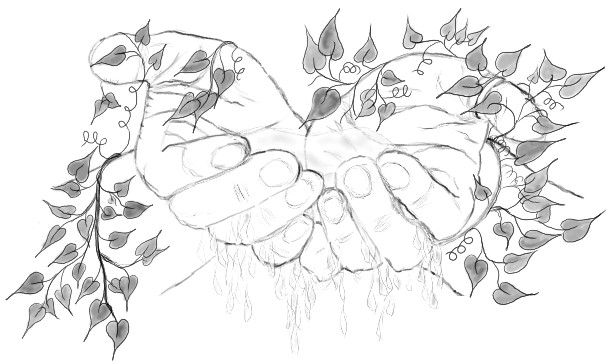
The section is started and represented by these hands here:

Digital sketch of a pair of hands cupped, fingers toward the viewer and heels of hands toward the owner. The fingers are somewhat lined and wearing double rings on the right-hand thumb. There is a small pool of liquid in the base of the cup, and numerous stylised droplets running through the cracks between the fingers. Twined about both hand and wrists are small, stylised vines, which are coloured a soft grey.

Unlike the others, I had a fair idea of what I wanted to depict here. Although it, too, has shifted away from the hands holding a verdant island in the sea to the above – less fanciful, but still quite fantastical. This image also marks the first where I was drawing things I could not see to copy, which made for an interesting initial panic, slowly overcome when I realised how much fun I was having. Is the image perfect? By no means. Does it convey what I want it to? Well enough. Did I learn anything making it? Loads, my friend. Loads. Including some fascinating facts about the mechanics of climbing plants…

Thursday, 17 February 2022

Joyful Flails

The next section in the Spectral Poetry Book is Joy. This might seem an odd segue from Anger, but I promise it makes sense. For a start, many of the same neurochemicals are released in a burst of happiness as from rage, which may account for the sense of intoxication that either bring. But to choose to experience joy is a powerful statement about your ownership of your life, and can take some practice, especially in Interesting Times like these.

You’ll doubtless be entirely unshocked to hear that the joys depicted in the book are rarely simple, and they’re often mixed in with something a little bitter, to leaven the potentially cloying nature of the section. Appropriately enough (though rather to my own surprise when compiling this), a fair number of the pieces are centred around food, and how that facilitates connections between people, demonstrates our common humanity. Many of them are quite short, but that means more happy poems in order to fill roughly the same number of pages.

The section is started and represented by these hands here:

Digital sketch of a pair of hands and a small amount of forearm. There are three sets of overlapping outlines with spread fingers - one with fingers pointing up and somewhat back, one with fingers slanting downward, one, fainter, somewhere between those two positions. The fingers are somewhat lined and wearing rings on middle finger (left hand) and thumb (right hand), with a double band of some kind, complete with buckles, just below the wrist of the right.

Except that, at the time of writing this, we were still debating about the one above and the one below:

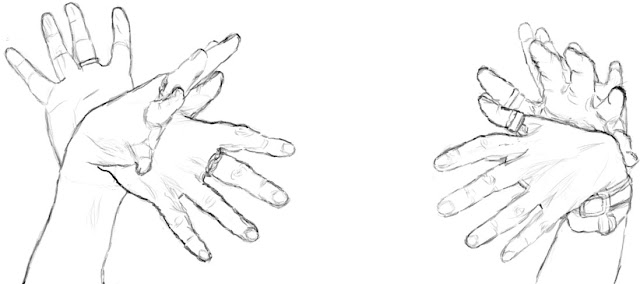
Digital sketch of a pair of hands and a small amount of forearm. There are three sets of overlapping outlines with spread fingers - one with fingers pointing up and somewhat back, one with fingers slanting downward, one somewhere between those two positions. The hands are solid and kind of cup each other as opposed to overlapping as before. The fingers are somewhat lined and wearing rings on middle finger (left hand) and thumb (right hand), with a double band of some kind, complete with buckles, just below the wrist of the right.

I knew from quite early on that I wanted to show the “flapping” stim that people use when the happy feelings breach all containment and you just have to jiggle. By the time the book has gone to press, we’ll have decided which one brings a more apt sensation of movement on the printed page…

Thursday, 10 February 2022

Angry Signs

The next section in the Spectral Poetry Book is Anger. A particularly potent distillation of – or diversion from – passion. Here you’ll find poems which talk about the importance of letting rage out to earth itself harmlessly, and the sensations of being helpless within your own fury when pushed beyond endurance, taking in, along the ways, some focuses for (or causes of) righteous wrath. The world is a difficult place, and sometimes anger is the only sensible response unless you want to risk giving up altogether.

This section will have the fewest poems, because most of them are hefty rants and I’m aiming for an equal page length between the sections. (At the time of writing this, it’s difficult to know if that ambition has worked… exciting…!)

The section is started and represented by these hands here:

A simple digital pencil sketch of two hands and forearms. The one on the right is constraining the fist of the one on the left. The one on the right is wearing chunky wrist bands.

Finding poses that summed up my complex relationship with rage was… tricky. There are a fair number of other options tucked into the archive, but this won out for all sorts of reasons.

Thursday, 3 February 2022

Passionate Gestures

Spectral (a forthcoming poetry collection from Burning Eye you might have witnessed me talking about before now… just a touch…) is divided into seven sections, each representing a broad vibe or emotional state/ expression. Each section is represented by a colour, and, within each section, the pieces form their own graduation through the topic. At least, that’s the theory! I must admit that I’m intrigued to find out whether this works for everyone who reads it (especially the guerilla readers like me who like to pounce at will and at random into collections).

However this pans out, I wanted to represent each section with its own simple illustration that wouldn’t rely on the colour coding. For ages I couldn’t think how to find symbols that were both universally evocative and adaptable to each vibe. (I was also racking my brains over what could be drawn by me with relative ease and without having to incur licensing fees, etc.)

In the end, I’ve gone with hands, partly for the reason that hands are used in communication a great deal – whether consciously or not – and partly because I, personally, talk with my hands a lot. And, while I suspect the gestures I’ve picked won’t turn out to be quite universally evocative (even looking back at my original notes I’ve clearly strayed quite far, in some instances, from my original intentions!), they’re proving an interesting study, not least because I’m, well, still learning how to draw, and hands are often cited as one of the most difficult things to depict.

Luckily, I’m still at the copying stage of skill acquisition…! (And you can see the specific illustrations I'm making for some of the individual poems here.)

So here’s the first one – Passion, as represented by these hands:

A simple line drawing of a pair of hands. One is heading out toward the viewer, palm down, digits splayed, almost as if it were about to play the piano! The other hand is curved in toward the owner, palm-up, fingers curled slightly stiffly, as if weighing out an argument. There is a chunky band around the wrist of the upright hand.

Basically – I look like this a lot when I’m talking about something I’m really into, and likewise when I’m performing, so these were the gestures I chose. I particularly like that they could be playing musical instruments as well as expounding on something I’m infodumping about…

It makes sense to start with Passion, really – a stirring of the blood, a determination, something to get us out of bed in the morning (or to keep us in it…). The poems here range from an awe-struck summoning through the shifting complications of long-term relationships, the sundering nature of lust and desire, and the resolution to own your own identity.

Thursday, 16 December 2021

Warning Signs

It’s been a crunchy couple of weeks for me, personally – crappy health and competing deadlines and all that. But I’ve managed to carve some time out to work on Spectral, so you get an update! A few weeks ago, I received the first set of official changes and suggestions from wonder-editor Harriet Evans, and managed to get some time with über-busy poetry powerhouse Bridget Hart of Burning Eye to talk about creating a content warning system for the book, so the past ten days has involved working on those two things, between bouts of illness.

Content Warnings are a touchy subject, even now. I, personally, used to be very wary of them – downright sulky about having to provide them where asked, in the past, if I’m honest – and we still don’t mandate them for the events that I run, though I do quite vehemently suggest nowadays that stronger opening topics do need a decent heads-up. Some people decry them as spoilers, or pandering, or incomprehensible – how are you to know what someone’s specific triggers are?! – but the last few years have given me some interesting insight into the value of them, and my approach has changed due to a couple of different demonstrations of best practice, and how much that contrasts with at least one demonstration of bad practice…

Edinburgh Fringe Festival is a great way to up your game (or decide that live performance art isn’t your game after all…) – the combination of pressure, reliance on yourself and others, the lack of resources and the wealth of opportunities, plus lots and LOTS of practice at honing your performance and hosting (and marketing, and networking, and quick-change costume, and hill-walking, and managing rejection) skills can be a game-changer. On top of that, you’re also witnessing how other people do it – well and badly! – and this can be really pivotal for your own work. Peering at my own hosting process these days, I notice that I’ve appropriated quite a few standards from other people that I liked: phrases and ways of expressing enthusiasm during warming a crowd up, adjusting the mic stand for people before they get there, providing a music stand so that people who read from hard copy can go hands-free, and the adaptation of Allographic’s infamous #NoApologies philosophy from people who hosted while I was recovering my voice. (I’d like to think that I’ve influenced a few others in turn re: no-kicking-down policies and checking performers’ pronouns as standard, but that’s not the point of this!) And my attitude to giving people more space in which to breathe at my events was massively altered by one friendly open mic in Edinburgh that I very nearly didn’t go to.

To Be Frank’s Edinburgh Fringe run in 2018 was produced by a group of young people from Bath, and hosted in Edinburgh’s radical bookshop. I came to show support to the featured cast and do a bit of open mic, and was blown away when a couple of lovingly pragmatic statements by the host shifted my worldview more than he could possibly know. Because I’d been to places where content warnings were encouraged/ enforced, but I don’t think I’d ever seen anyone say something like: “If you’re getting overwhelmed, please feel free to wander out into the rest of the bookshop if you need to take a moment, and then come back whenever.” It was the corollary to “you might be triggered” that I’d been missing all that time – “if you’re triggered, or potentially triggered, you can go, take care of yourself, and return, with explicit permission.” Knowing that I could leave and come back if I needed to… meant that I didn’t need to. It was quite an extraordinary experience, and I have now worked it into all my hosting duties, whether online or in person. You can come back is a huge thing to hear; you don’t have to reach fever-pitch and run away for good/ dissociate frantically while stuck in the audience. You’re welcome to practise good self-care.

And of course there was an experience of seeing it done badly which resolved me to be even stronger in my defence of content warnings. Short version: A Certain Famous Musician had a gig in Cambridge a few months before lockdown which almost had me on my knees with rage and anxiety. I started feeling quite quickly like I was the only person not signed up to the personality cult, and I left with most of my upper body in tetany from clenching my fists so hard. She sauntered through the audience, touching hands like a revivalist preacher, reached the stage, and launched into an anecdote which had immediate and graphic themes of what probably many would describe as sexual coercion and dubious consent, let alone underage activities and deeply sketchy power and age dynamics, then trilled: “Trigger warning! Hahaha!” into the somewhat stunned silence. She then told the audience that they could call out for her to play a particular riff when they were feeling sad and overwhelmed, because there was a lot of heavy stuff in the show. The third time someone asked for it, she was already cursing them and showing every sign of aggressive reluctance to comply, all the while telling us at every other turn that she practised “radical compassion”. If actual and timely trigger warnings (and actual pragmatic care) had been offered for the a) heavy, b) rambling, c) viciously self-aggrandising and seemingly endless show, I might have engaged better with the subject matter/ not binned the artist from my list of icons.

In a similar fashion, and with similar timing, I started interacting actively with fanfic in early 2018. Getting into the habit of reading – and writing – stories of sometimes graphically distressing topics turned out to be much easier to process/ avoid when feeling fragile due to the tagging system (which, to be fair, not everyone employs punctiliously). Knowing when/ how/ if to back out of something that tweaked my own personal “nope!”s didn’t lead to me having a more anodyne reading experience by any means, but it meant that (nearly) every engagement with the difficult stuff was done with informed consent, and the feeling of control I had over those situations helped me process topics that I did need to address, but which I might have just run away from entirely otherwise. It’s always jarring, by contrast, to find that book- and movie-buying is more fraught – I’m about to spend cash on this… am I going to end up chucking the thing across the room, having been ambushed for the sake of an author’s need to control my experience down to the jump-scare? or will I get my money’s worth?

Detractors of content notes and trigger warnings like to say that “life doesn’t provide trigger warnings!” Sure, but that’s wildly beside the point, in my opinion. Because, adequately informed about the potential dangers of a situation, we can choose to take precautions or avoid altogether. Besides, not only does nature provide plenty of safety warnings in the form of colouration, etc., we humans set up vast swathes of safety measures in actual, 3D life as well as art to give people that very choice: Low Bridge; Flood Warning; Falling Rocks; Oncoming Train; Construction Site; Wash Before Use; Wait For The Green Light; Contains Peanuts; Strobe Use; Foul Language; 18+; Danger: Quicksand; sirens and flashing lights; car horns and airbags; seatbelts; safety harnesses, goggles, and hard hats; lightning conductors; fire grates and tempered glass; gauntlets and sword guards; steam valves; antihistamines; steel toecaps; oxygen masks; lifeguards and buoys; red flags; Beware of the Dog; Here Be Dragons. A large part of the ongoing success of human society is its collaboration on preventing and mitigating danger – both physical and mental. Let’s face it: folklore and mythology is about 80% Don’t Talk To Strangers; Deep Waters Contain Scary Things; and Don’t Wander Off Into The Woods By Yourself, For Fuck’s Sake. (A lot of the rest of it appears to be about the dangers of jealous family members, which is interesting, but definitely a discussion for another time…)

Besides, if art is a conversation (and I strongly believe it is – or should be), then the power and control need to be equally shared between all participants, explicitly. And if art is a means to safely process the difficult things about life – a co-constructed virtual reality, if you like – it needs to practise compassion and informed consent in order for the messages artists want witnessed to be engaged with clearly. Anything else feels somewhat like bullying, to my mind.

So what’s that got to do with Spectral? you might be asking, if you’ve got this far and not been thoroughly derailed by my digressions (hi, nice to see you; thanks for persisting; please bear with me a little longer!). Well, I wanted to find a way to give common content warnings for the pieces without impinging on people’s reading experience – a way for those who wish to stay as safe as possible to do so, but also a way to not get “spoilers” if you’re feeling robust enough to handle any surprises. And, let’s face it, if you know anything about my work to date, you’ll be unsurprised to find themes of sexuality, gender, relationships, mythology, and the power that memory can hold over us popping up in the book. Talking to Bridget about it, she suggested a discreet colour code, which turned into me suggesting symbols (since internal colour was out), and together we worked out a suitable set of warnings (whittled down from a terrifyingly comprehensive 50-something to 27).

The, uh, fun thing about occasionally being so ill that you can’t sleep, is that you can find good distraction and productivity in small, low-stakes tasks. In this instance, having done a bit of research into standards for emblematic representation, and realising that I would have to draw the symbols myself where possible due to copyright restrictions/ lack of cohesive options elsewhere, I got stuck in and started ticking them off, starting with the quick wins. Having a drawing tablet and the recent practice in copying things has definitely borne fruit, as I seem to be much more able to transcribe my imagination than before. Using CorelDraw, I would scribble simple, sketchy versions, then play with the nodes to pose the figures. A lot of duplicating-and-mirroring gave some symmetry (better than relying on my current ability to draw something suitable twice reliably), and behold!

These are very much in first draft status, so I’m going to share a bunch that are either particularly common in the book, or about which I’m rather proud… or both.

A set of 14 cartoon images in black and white, scattered a little randomly across a square. From left to right, top to bottom, they are as follows: 1 A simple stick figure with arms and legs raised and akimbo. Above is a crossbar with thin, pale lines going from the ends of the sticks to the figurative hands and feet. 2 An outline of two pieces of a shattered love heart, leaning away from each other with zigzag lines to indicate the break. 3 A black candle with a white flame. 4 A love heart with a biohazard warning sign inside it. 5 A pair of stick figures. One is standing, bent over, one hand on their hip, and pointing with the other. Jagged, grey lines emit from their face; their focus appears to be on another stick figure who is hunched up and seated on the ground, back curved defensively toward the standing figure, head bowed. 6 A stick figure walking with jagged, grey lines emanating from head, elbow, back, knee; one hand is held to their face. 7 Two identical figures reversed and side-by-side; they look a little like two exclamation marks lying horizontally in opposite directions, the "dot" placed roughly one-third of the way along the other figure. 8 A grey circle with a horizontal line through it superimposes a simple, horizontal, oval figure with a bulbous protrusion at one end. 9 Head and torso of a stick figure has its head bowed and is holding its face in its hand. 10 A rounded cartoon figure has a very simple, neutral/sad face and has its arms crossed in front of it, shoulders hunched. 11 A grey circle with a horizontal line through it superimposes the transgender symbol (a combination of biology symbols for female, male, and both, centred around a single, unifying circle). 12 A simplified cartoon of a human skill (without lower jaw or teeth) faces the viewer. 13 A cartoon figure buries its face in both hands, shoulders hunched. Three jagged, grey lines emanate from its head. 14 Two cartoon figures - head and arms only - gesticulate with stick arms and frown at each other (the only facial feature visible are their eyebrows) while jagged lines jostle for space between them.

In alphabetical order, the symbols above represent: bullying, childlessness, chronic pain and fatigue, conflict, death, depression, despair, implied sexual content, manipulation, mourning, regret, relationship breakup, toxic relationships, and transphobia.

Would love to hear if you can tell which is which, and what you think (bearing in mind these will probably need to be about a centimetre high each in the finished version!). They will, of course, be properly labelled in the final version!


Thursday, 25 November 2021

Take Cover

It’s here! you asked how to pre-order Spectral, so I’ve set up a means to do so on the new Allographic Big Cartel shop. Which means I get to show off the beautiful art that Sa’adiah Khan created for the front cover of the book from Burning Eye.

I knew I wanted Sa’adiah’s art for this project well before I knew that Burning Eye were going to take it. As soon as the concept blossomed, I realised it needed her take on it to bring it further to life. You may know her as a community artist in Cambridge and nearby – she’s dedicated to bringing art to life in tiny, intricate, intimate pieces, and huge murals, broad and bountiful, and one of her most enduringly beautiful pieces is the collaborative mural which still adorns our local Co-op in Chesterton.

Sa’adiah had already provided the artwork for my show The Selkie a few years ago, somehow taking my rambling depictions and turning them into (sometimes eerily accurate in matching my mind’s vision) images to match the narrative, and I was thrilled to manage to book her for this project shortly after Burning Eye confirmed publication. 

With this being a much vaguer conceptualisation, she had to work in innovative ways to pull out what I needed, and, after various colour cut-ups (literally), kaleidoscopic animations, consultations, and very patiently tiffling about with hues and shadows until I was happy, she produced this absolute beauty:

a series of jagged circles of different colours. The whole implies a mandala, or a rather geometrically exact flower against a patterned, greenish background. The outer "petals" are yellow shading through orange to red, with triangular points at either end of this spectrum, outlined in black to give an impression of depth through shadow. The inner "stamens" are shades of very light aqua and teal in the centre, in a series of quite subtle, tiny waves, moving outward to a textured purple.

Isn’t it lush?! I can’t wait to see what Clive does with the design, and am looking forward to making badges of it. In the meantime, please enjoy losing yourself in the layers (and, better, head over to Sa’adiah’s website to see more of the gorgeous colours and holistic visions she has to share; you might even find yourself joining in a drawing workshop!).

And, if you’re feeling as though, this close to Christmas, you’d like to support an independent publisher who does a great deal to make the work of performance artists come to life in print form, you could do a lot worse than donating to or buying some work from Burning Eye who, like a lot of artistic platforms, have been severely hit by the Pandemic.

Over on my poetry blog I’m also sharing sneak peeks into artwork I’m producing for certain pieces in the book, so do check those out – I’m hoping to bring new ones out every week from now until launch.


Tuesday, 24 August 2021

Applying Myself

 Bright yellow background with black text. There is a picture of a free-floating balloon with string dangling on the top left and a microphone on a stand on the bottom right.  Text reads, from top to bottom: "Burning Eye Books" with a tagline that looks as though it was spraypainted through a stencil: "Never Knowingly Mainstream", with the year 2022 written underneath. Below this: "10 Years of publishing slam/ stand up/ spoken word/ performance poetry".

Next year sees the tenth anniversary of publishing house Burning Eye Books, who’ve produced the collections of some of my favourite UK performance poets. Their focus has been consistently on platforming the work of word-wranglers who inhabit that interesting place between poetry, theatre, music, and stand-up. The sort of people who used to be traditionally, well, invisible to standard page publishers.

People like me, I suppose.

Imposter Syndrome is a funny thing – it can have you thinking you’re cheating and faking, especially when you do well, especially if it’s taken a while for other people who at least look like arbiters of success, to recognise your achievements and skills. Especially if you’ve ever been given grief for your endeavours. It makes it difficult to put yourself forward for opportunities because, well, they’d never pick me.

Last September someone told me that the next window for submissions to Burning Eye Books would give specific emphasis to welcoming artists inhabiting that interesting place between male and female. The sort of people who used to be traditionally, well, invisible to standard institutions.

People like me, in other words.

So I, high on the adrenalin of an excellent night of slam poetry, vowed (in front of witnesses) that this time, I’d actually apply. And in the new year, having moved into a different phase of my life on several fronts, persistently encouraged by a bunch of lovely people, I made a spreadsheet (obviously) for all the poems I felt folk would want to read, and started cataloguing them. And then I got ill. And then I hurled myself during the final 48 hours before the deadline into writing a proper submission for a grown-up version of the kind of stuff I’d been producing (a sample, a bio, and a proposal for the shape of the book; why will people buy this? who are you? what makes this – and you – special?). And, for once, I wrote that down and told them. (And got friends who know their stuff to check it, and they reminded me about other things I could say, so I said them too.)

Writing poetry is easy. Delineating your literary worth in an online form? Bit more of an ask.

Anyway, you may have seen this on social media already, in much pithier, more confident-seeming formats. But, in short: Clive and Bridget looked at the proposal, and in March, they said yes…

Bright yellow background with black text. There is a greyscale photo in the middle which looks as though it’s been taped onto the page, and a picture of a free-floating balloon with string dangling on the top left and a microphone on a stand on the bottom right.  Text at the top reads: "Fay Roberts ze/zir they/them". The photo below is of a slender, white person with slightly wild, curly hair of an indeterminate colour to their shoulders. There is a bright light behind them and they are looking up and to their right with a slightly tortured expression, mouth open as though speaking. The placement of the balloon means it looks like they’re staring at it. They are wearing a white top with three-quarter sleeves and an open, grey waistcoat over the top. Their left hand is raised, palm open, and they’re wearing a ring on their thumb.  Text at the bottom reads: "Burning Eye Books" with a tagline that looks as though it was spraypainted through a stencil: "Never Knowingly Mainstream". Lastly, there’s the year 2022 written to the right.
(Author image by Matt Widgery at the SHINDIG Storytelling Special.)

The book is currently called Spectral. It’s going to have a very specific concept underpinning its construction, and very beautiful cover art by local Cambridge artist Sa’adiah Khan, and I’ll be producing an audiobook version to match the current release date for the physical book in March 2022. You’ll be able to buy it in bookshops and online and did I mention that I’m still freaking out about this?

Today the knowledge that this is actually happening sinks that bit further into my psyche, and I’m abruptly grateful that the process of publication takes a lot longer with big publishers than with my own platform. (Oddly enough, my label, Allographic Press, has seen other of our writers ’graduate’ to Burning Eye and… I guess I’m one too, now…?)

The tenth anniversary publications list for BE looks like a grand mixture between some of my favourite poets (including people I’ve acted with, which is an interesting bit of world-collision!), people I’ve only heard of, and others I’m really looking forward to getting to know:

Bright yellow background with black text. There are a list of names down the middle, and a picture of a free-floating balloon with string dangling on the top left and a microphone on a stand on the bottom right. At the bottom is the year 2022.  Names list top to bottom: "Ash Dickinson, Sally Jenkinson, Panya Banjoko, Katie (Tom) Walters, Vera Chok, Pascal Vine, Inizo Lami, Ross McFarlane, Leena Norms, Jemima Foxtrot, Leyla Josephine, Jack Juno, Maz Hedgehog, Fay Roberts, Bibi June, Louise Fazakerley, Mark ’Mr T’ Thompson, Nora Gomringer"

So I’ll be keeping you up-to-date with progress as it goes, in between small bouts of freaking out and rushing to complete deadlines at the last minute because really… that’s not going to change any time soon, let’s face it… Expect to see at least hints of art and contents pages, and possibly the occasional flail about audiobook production and other such fun stuff. I’ll be posting on Instagram, Twitter, Facebook, and possibly Soundcloud about All This, but expect the longer rambles to turn up here. And yes, this may be the final impetus I need to actually update my website for the first time in… okay, I’m not going to work out how long it’s been, just crack my knuckles and get on with it!

To everyone who’s encouraged, proofread, witnessed vows, made space for me to write in, squeaked with glee, and/ or shown absolutely no surprise whatsoever when I’ve told them this news… thanks! And if you’ve read this far, thank you too!

See, it’s important to have good friends around you. Folk who’ll gently (or not-so-gently) nudge you toward the things that make your life brighter, remind you that there’s space in which you can make and grow and thrive. That there are chances for those who might have considered themselves invisible to standards they think unattainable.

People like you. And me.

Blimey…

Saturday, 27 March 2021

Showcase Your Words at the #VFreeFringe

 Hi Folks,

I’m writing this with my PBH’s Free Fringe Spoken Word Artistic Director (try saying that seven times quickly!) hat on:

This year, we’ll be putting on a digital version of the Fringe. Yes, things may change for the better and there may well be possibilities of socially distanced shows in the actual city of Edinburgh, but we also want to broaden out what we do, making it more accessible and more innovative, while still remaining free to both performers and audience, emphasising the role of a creative community in supporting each other, especially in these still-weird times.

We realise that a fair number of people find the idea of running/ creating digital shows unfamiliar and disorienting/ disconcerting, but we will also be providing a plethora of advice, guidance, tips and tricks (to audience as well as creators!), and face-to-face (online) training, as well as putting together a catalogue of useful resources from equipment and venue hire to filmmakers and audio specialists to marketing and social media integration. And we want to emphasise that you don’t need fancy equipment to make digital shows – one of our experts has been waxing lyrical about the sheer amount of high-quality content you can create with a smartphone (and will be putting together mini how-to instruction videos with that in mind, among other things).

And the difference between this and the in-person Fringe is that the only limit is your imagination. You can give us 10-minute videos to platform or 24-hour recitation marathons. You can pre-record, do live Zoom shows, give us a Facebook Livestreaming link, or give us the means to platform your audio-only podcasts, interviews, etc. If it belongs online, we want to help you broaden your audiences during August. We’ll also help with social media tie-ins now we have experts on board to help with that.

And we’re looking at clever ways to include the social aspects of getting together during Fringe as much as possible. Not only by including open mics, slams, and other cabaret events, but also virtual social spaces for people to drop into and chat with each other.

If you’ve always wanted to give the Edinburgh Fringe a go and have been limited by budget, time, energy, etc., this could be your opportunity to not only get involved for the first time, but be part of the inaugural Digital Fringe. And if you’ve been missing the Fringe, we’ve been missing you too – it would be great to see you!

I’ll be running online discussion sessions on Zoom specifically for people who want to bring spoken word shows to the Free Fringe during April and May 2021 (every Saturday, 12:30-13:30 GMT) and want to talk about the possibilities in person, as well as running training sessions on running good Zoom performance events. If you’re interested in finding out more, there’s a Facebook group for all interested parties: https://www.facebook.com/groups/vswpbhff21 and you can sign up for discussions by going to https://discussvswpbhff21.eventbrite.co.uk to reserve a place. (You need to have an authenticated Zoom account to join.) Watch this space for news about the training sessions, coming soon.

In the meantime, any queries, please comment here or email pbhspokenword @ gmail dot com

Friday, 21 August 2020

Talking About Talking About Thinking About Change

I’m heading back to “real work” soon – or at least that part represented by an office job (which will see absolutely no geographical shift away from my study/io for the moment, so adaptation will be… challenging on that front) – and, as I ease back into morning meetings (unnatural!) and people with different priorities and vocabulary to those with whom I’ve been interacting of late, they’ve already been asking how my year of Sabbatical has gone, what I’ve got up to, all that. Unlike those who use Sabbaticals to travel the world, I don’t have a ready store of photos and maps to demonstrate, and the last 5-6 months of this have been… less than ideal, let’s say… What I will say about residencies and commissions and adaptation to extreme conditions and writing fanfic to keep myself sane (hyperfixation on research has been a great tool of denial) and finally being able to pick up the voice work again will – I suspect – sound super-vague, though I should really give these clever, sociable, professionally good communicators the benefit of the doubt! Besides: in some ways we’ve faced more of the same challenges this year than might have been anticipated…

And so, ironically, it’s the most recent work I’m engaged in that might resonate most with people whose job is managing business change, and the psychological stages that go with it. I’ve been creating a poem commissioned by someone who needs to use it to talk about death and grief in a non-religious way. (So obviously it’s one enormous metaphor and, being me, I’ve snuck in references to the four elements, water being somewhat dominant here.)

One of the most fascinating aspects of this process has been writing something that needs to fit someone else’s voice, to a certain extent, because this poem is to be a tool that will doubtless get reshaped by use. Today’s discussion included not only hearing which bits they felt they could use and others… less so… but having the client read it aloud, while I tweaked a couple of lines to fit that, noting what stumbled and what flew, making further notes for more deep-seated transformations later. This is something I do on an almost unconscious level when writing something for my own voice, but doing it for another feels almost like brand-new process for me, and luckily the client’s ability to self-reflect is both skilled and generously shared.

I’m pretty sure this process could not have worked without that trust.

It now occurs to me that this is (new analogy alert) like creating a garment for someone else to use - not only do you take detailed measurements at the beginning, but you have to get them to try it on so you can make some parts tighter, others looser, and ensure that yet others can stretch as necessary, depending on circumstances. Sometimes you have to unstitch an entire panel and do it again.

And the knowledge that the creation will shape the user as well as the consumer is a heady one.

This poem is going to be released publicly as well, at some point in the future, for other people to use if appropriate, and I find myself quietly excited by that prospect, again in a different way from usual. It feels good to make something for people to use, when art is so often seen as a decoration, a luxury, a nice to have, when it actually underpins so much of what it means to be human, connecting our present to past and future, communicating so many things and used everywhere. That this is to be, far more explicitly than usual, a tool, gives me a very calm kind of satisfaction.

And if that’s all I ended up having to show for this year, it would be a mighty thing indeed.


Photograph of the River Cam on a sunny, summer day, from one of the many bridges. There are rainbowed lens flare strands coming from above, but the sun is only seen reflected almost painfully brightly in the broad, tranquil river, on which there are swans (white scribbles on the water that might also be other stuff!). Large trees in full leaf frame the river and rowing club buildings are visible on the left-hand side, with canal boats moored on the opposite bank. The patch of common land seen on the right is a brilliant green, and there are a few fluffy clouds in the light blue sky.
River Cam, August 2010

Sunday, 5 May 2019

Out, Damned Spot! (Or: some people have trouble letting go, an exercise in catharsis.)

I’ve been bottling this for a couple of days. It is, however, time to get this poison out of my system so I can get on with some of the many awesome things my life contains at the moment. Last Friday (3-May-19), I hosted a Hammer & Tongue Cambridge as usual. It was a fine night in many respects – excellent performers, including last-minute support act the divine Rebecca Cooney; pretty lovely slam; one of my favourite local performers won; I got to see one of my closest friends after a few months apart; we got decent numbers in the audience; and the headliner, Jah-Mir Early, did his usual breath-stealing, improvisational spoken word magic. Why am I needing to vent about it?

Well. Glad you asked. I’ve been running Hammer & Tongue Cambridge as the host since January 2012. Before that it was run for just over two years by another host, who I won’t name. If you know who it is, you know who it is. I started “helping out” in April 2010, which meant: doing front of house, scoring the slam, and latterly doing a great deal (if not most) of the publicity work. In that time, HTC has moved from tiny, dingy pub venues (which I would also have to set up much of the time, and for which I bought lighting, basic sound equipment, etc.), through a much nicer bar venue, to a local arts centre which is wheelchair accessible, clean, and pleasant to be in. Where I no longer have to set up the box office myself, hoick the sound and light equipment up two flights of stairs, and fight my way out with them at the end of the night through lairy drunks (and that was in the nicer venue). Where forty people in the audience was considered the giddy zenith, that’s our baseline now. Our regional final sells out. We have a decent social media following on multiple platforms. We’re proudly part of a larger spoken word scene in the city which is burgeoning all the time. We run on time, break even/ turn a small profit on occasion, and can afford to pay headliner and support act small but reasonable fees without any external funding. The audience and performers are as safe as we can make them from insults and threats of violence.

None of those latter sentences should be remarkable, really, but they’re stated in strong contrast to how things were before I took on the mantle after the previous host stropped off because virtually no-one was turning up to the events, and no-one offered him the requisite “respect”. The penultimate two events under his aegis were totally paid for by me alone (headliner fees, publicity, etc.), and I had to absorb a great deal of aggression and posturing from this stale breadstick before we could all move on.

So far so okay, Fay, what’s your point? At the last event, one of the Old Guard, one who used to come and slam/ watch on the regular under the previous regime turned up. He stood out from the rest of the crowd because he got increasingly intoxicated (I use this word carefully) and lairy, having to be repeatedly asked to shush while other people were talking. Afterwards, having been sought out to be praised/ thanked by various members of the audience and other performers for my crowd control skills (which really shouldn’t have to happen!), I made the error of talking to this chap outside the venue as I waited for the headliner to get back. I warned myself against the desire to mollify aggressive men, but there you go – part of me wants as many members of my audience to walk away happy as possible.

Among other jabberings, he took the time to faintly praise me for “carrying the torch” (sic) of Hammer & Tongue Cambridge. It took me until I got home to work out quite why I was so annoyed by that particular phrase (probably because it was drowned out by what happened next). When I wryly thanked him, saying we’d carried it but changed its shape somewhat, he took the opportunity to complain about how he’d felt tense and repressed (at least, I think that’s what the crouching body language and bouncing, palms-down hands implied) throughout. Maybe I’d noticed, he confided, that he wasn’t entirely sober by the end. Yeah, I had. He theorised about my hosting style being responsible for this tension. This tension that, as far as I could tell, only he felt. He then appeared to do an impression of me speaking, murmuring: “Mehr, mehr, mehr-mehr-mehr.” Then, as I barely responded past a side-eye from under my hat, repeated it: “Mehr, mehr, mehr-mehr-mehr,” complete with smirk and crouching little dance to complement his “feeling repressed” gestures of earlier. Yeah, I got it, dude – you think I’m a less than dynamic presenter.

I was able to pay the headliner and leave shortly after that. By the time I’d got home, after lengthy catch-ups with said beloved headliner and my other too-long-unseen friend, it turns out I’d let this fucknugget get in my head. “Mehr, mehr, mehr-mehr-mehr.” – the sound of a softly-spoken, female-presenting person doing their job. “Mehr, mehr, mehr-mehr-mehr.” – the sound of a mean schoolteacher oppressing the God-given rights of naughty men to be as loud as they want while someone else is talking. “Mehr, mehr, mehr-mehr-mehr.” – the sound of someone who’ll never measure up to the shouty posturings of a third-rate poet and tenth-rate event host who used to drunkenly insult me from the stage and, I discovered years later, buy/ sell drugs in the carpark during the tediously extended intervals, taking up disproportionate swathes of time on the stage with his own repetitive work. My nights aren’t perfect. I could work harder at getting more people in, do more publicity, make more of a spectacle of it, but I’m never going to get loud just to suit other people – I decided long ago that that course of action gets you nowhere – they’re just going to have to lean in to hear better.

Last year a headliner calmly told the audience that he wanted to stalk me, and they seemed to lap it up. Certainly no-one told him off or offered me support afterwards. One of the audience, in fact, told me afterwards that I loved the headliner for it. I didn’t remonstrate with either of directly (too many years’ training of “mollify the man, soothe him in case he hurts you”?), but I’ve written a poem about it, so that’s all right. {eyeroll} It’s still a tough world as a female-presenting performer and MC. For every ten people or so who think I’m doing a good job, and loves what I’m doing as an artist and a host, there seems to be one who thinks I’m fair game for stalking, pervy comments about my voice, claims that my voice is “fake”, off-stage racist diatribes they think I’ll support, or jittery banter about my unshouty hosting style. “Mehr, mehr, mehr-mehr-mehr.”

Carrying the torch? Fuck you, buddy. How about ditching a toxic legacy? How about transforming the event into something welcoming and professional? How about feeding and transporting that guttering flame and building a hearthfire? How about soldiering the fuck through with no support from my predecessor’s Old Guard? How about nearly four times the length of service in this event alone compared to his? How about the fact that I run a stage at Strawberry Fair that’s dedicated to spoken word and brings people in from fifty miles around? How about my five-star shows at Edinburgh Fringe? How about my BBC and other commissions? How about my national reputation as someone who works to raise and safeguard the spoken word scene? How about my national reputation as professional, hardworking, and talented? How about my well-known propensity to make every performer and audience member feel welcome unless they’re a hate-mongering douchecanoe? How about my small press, my open-hearted open mics, my fund- and awareness-raising for local charities, my groups set up to encourage and foster peer support among the spoken word community?

(Do you know how hard it is to write all the above without the likes of these Mehr-mehr-mehr arseholes’ voices chiming in my head telling me off for showing off? The lifelong legacy of making myself smaller that I have to actively resist every time I leave the house, let alone this?)

For some people you’ll never be other than the last (or first) time they saw you. For some people I’ll never be other than the victim of bullying at school, whichever part of that experience they were part of. For some people I’ll never be other than that administrator who was always late to work. For some people I’ll never be other than a certain person’s pathetic ex. For some people I’ll never be other than the quiet one who lost so spectacularly at whichever slam they saw me lose spectacularly at. For some people I’ll never be other than the nerdy sidekick of a misogynistic poseur. For some people I’ll never be other than a classical singer and choir conductor. For some people, I’ll never be other than Melody Starchild. For some people, I’ll never be other than the person who encouraged them to get into spoken word. For some people, I’ll never be other than the person who wrote that poem for their anniversary that made them cry. For some people, I’ll never be other than the first person who taught them about clerihews. For some people, I’ll never be other than the first person to publish them. And for some people, presumably, I’ll never be other than the Glastonbury Festival blogger 2019.

Tough breaks. You’ll forge your own destiny and some people will want to keep you down, cling onto the old version of what you were. Oddly enough, that was the subject of one of the first performance poems I ever wrote, way back in 2007, striving to survive on a scene that depended on the goodwill of the people still labelling me that person’s ex, the interloper, the Welsh one, the “failed lesbian” (true story). The crab bucket will always want to cling onto you, keep you chained, call you by your deadname, keep you from the light. The best thing for these remnants is to let them go with love, knowing that the shit you went through was one of the things that forged the stronger person you are now, but that you owe it – and these nostalgia hounds – absolutely nothing for the joy of finding your own path, your true name, the clothes that fit you far better. Let them go, and use your energy to cherish the people who’ll expand their first image of you into something complex and spectacular, and will help you find that joy. And let one of those people be yourself.

Photo of Fay Roberts hosting Hammer & Tongue Cambridge - (c) Nikki Marrone

Monday, 11 March 2019

So, That Happened...

(If you want to skip the build up via a history lesson and go straight to the announcement, click here.)

The first time I went to Glastonbury Festival was with my recently-ex-girlfriend – her dad had already bought the tickets for her birthday and we were trying hard to be friends at that point. We ended up camping on a slope above the Pyramid stage with my ex-boyfriend and his sporty mates. It was 2000, the year the Festival was massively invaded by ticketless rebels, and it’s a good job I’m not made panicky by crowds, that’s all I can say. It was, however, a year of record high pollen count, which saw me necking antihistamines and being barely able to breathe except at night. Add that to me being sensitive (and sometimes wildly allergic) to many of the various forms of weed in evidence, the sheer weirdness of spending time with my ex-partners, and it being less than a year after my mum had died; to say I experienced mixed emotions over the course of the long weekend would be stretching the phrase somewhat.

The next time I went to Glastonbury Festival was in 2003. I’d not long moved to Milton Keynes to live with my then-boyfriend. His disabilities meant that we didn’t camp (much to my not-so-secret relief), but stayed in a B&B nearby and drove in every day (that is to say: I drove in and out every day). A failure to communicate meant that we had to drive back to Milton Keynes the morning after we’d arrived to fetch the tickets, which we’d each assumed the other was bringing. I also developed some excellently hench upper body strength pushing a 14 stone sailor around fields in a manual wheelchair. We watched a lot of bands that he had only ever admired from afar, and I discovered reserves in myself that I might not have considered otherwise, as well as how much Lucozade can save your life when you’re driving that many miles sleep-deprived. And that Glastonbury-the-town was both beautiful and weirdly familiar.

The next time I went to Glastonbury Festival was in 2005 with my housemate, and our mutual friend from Milton Keynes. We camped quite far away from the main part of the festival on a well-found, gentle rise of ground, surrounded by many absolutely brilliant hippies. This turned out advantageous when the average rainfall for the whole of June came down overnight on the Thursday (lightning striking at least one of the stages during this time). I was inclined to blame the rain-summoning wooden frog I’d purchased the previous night which made a deliciously realistic croaking sound when I rubbed its wooden rod over the ridges of its back (which I demonstrated to everyone I met). I had a curiously restful night, all things considered; I’d finally worked out, after several painful years of camping at festivals, that I could wear earplugs overnight and sleep better, so ignored the thunder and rain (I grew up in Wales, after all) and had slept significantly better than my housemate, who was significantly less inured to thunderstorms. The main part of the festival was flooded, water running down from the higher ground like bona fide rivers in full spate.

A wee bit wet
Can you see the woman in the background floating serenely on a purple blow-up chair?!

We put pedal bin liners over our socks and waded into action, buying cheap wellies on site that we still have today (as well as me buying myself a massive stick with a dragon’s head on it – it seemed like a great idea at the time, and subsequently proved useful in both mud and moshpits). We had more regrets about the 2am hog roast, which left us in a very bad way later, and my OCD was tested to its creaking limit by the mud and ankle-deep slurry from the flooded toilets, but survived sufficiently to want to go again. It was also the first time I’d been to an outdoor festival while menstruating. I don’t recommend it. We watched the sun come up over the stone circle on the Sunday and accidentally took part in a hand-fasting ceremony (as witnesses; the gentleman who officiated turned out, many years later, to be someone I now know in Cambridge as one of the other organisers at Strawberry Fair…). When we told people about it after we got back to our tents for a disco nap, one person said “Oh! Cool! I didn’t see that on the programme…!” Hmm.

The last time I went to Glastonbury Festival was in 2007 with my former-housemate-now-girlfriend, and the same mutual friend as before (who didn’t know that we were going out). In order to get the tickets, we’d had to inveigle internet use from the owner of the hotel we were staying in for a hen do in Brighton (this involved flattery, late-night listening, and an early morning shoulder massage) the night before tickets went on sale. I honestly don’t know how our luck held so well to get tickets, but get them we did. Once there, we spent a far greater deal of time in the more alternative parts of the Festival (green fields, cabaret, etc.), as the main parts seemed to have changed their atmosphere significantly from the first time I’d been. I wrote, somewhat meanly, about being "… fed up with the shiny Sloanes/ Uncomfily dressed-down with all/ Their moans about the bogs and bands,/ Who sign African petitions/ Yet refuse to bin their cans…" Because by that point I was writing poetry, but was too chicken to sign up for the open mic/ slam (I think there was a slam?) at the difficult-to-find, tiny poetry tent (though, thanks to my partner dragging me along, I did get to see Sophia Blackwell for the first time, resplendent in what my memory insists on picturing as a froofy cocktail dress and red wellies, along with Danny Chivers, performing poetry and hooking me even further into the notion that this was something I could be doing). This time, instead of bucketing it down for four hours, then being gloriously sunny, it was persistently wet in a phenomenon known technically as a monsoon (no, I didn’t know there was such a thing as a British monsoon either). I left the farm feeling very old, somehow, and coughing my lungs up for a couple of weeks afterwards.

(I look back at what I blogged about the experience and I shudder at some of the language I use, that now looks incredibly snobbish and horribly like internalised misogyny to me.)

I applied several times after that to perform at the Poetry & Words stage. It’s hard to say whether it was including footage of the aforementioned poem which did for my chances, but I strongly suspect it was purely because I didn’t have the experience, and similarly didn’t have high enough quality footage (or poetry, arguably) to be persuasive. A few years of failed applications (and failed attempts to get tickets the normal way) later, I decided that I was never going to get to play in those kinds of leagues, and resolved to be happy with my spoken word scene tier. (Or, to put it another way: I decided that the pain of rejection was too much and played it safe for a few years.)

So to say I was shocked when I received the email a couple of months ago asking me if I’d like to be part of it would be putting it mildly. I rushed to my girlfriend (same one as shared the last two Glastonbury Experiences) to check whether I was reading it right. I was. Instead of sitting on the opportunity for weeks until they gave it to someone else, as I’m so magnificently good at doing, I wrote back with alacrity and said “Yes please.” So now, somehow, twelve years later, I’m going to Glastonbury again – this time as official chronicler of the event from the perspective of the Poetry & Words stage. I’ll be writing, and the brilliant Scott Tyrrell will be making art of it all, and between us you’ll be as good as there while reading the blog.


(No, I have no say in the poets chosen, and no, I can’t get a plus-one for you. If I could, I’d be bringing my partner, oddly enough…)

I am still equal parts terrified and delighted, and I suspect that this state of affairs will continue for the next few months (during which I’ll be telling you about the line-up as it’s released, so please do follow the blog!).

Monday, 4 March 2019

#Multicultural #Cambridge (or: I've only just realised that #Brexit's nearly here)

I’ve been living in Cambridge for nearly ten years now (come July) and – much as I rail at its many structural inequities, and the inaccessibility of many of the wonderful things it does, there are some major things (and people!) I properly love. Among all the art, history, culture, and technology (and things which span all of these categories!), there’s an attitude of proper liberalism and a truly international spirit here. The first time I visited with a view to “we’re going to live here shortly” I heard about five languages spoken on the streets in the first hour or so, and it immediately felt more home-like than Milton Keynes, where I was living at the time.

Without Milton Keynes I may never have been pushed to write poetry (take that as you like!), but I grew up in Cardiff, a massively multicultural place, raised by polyglottal people who considered themselves Europeans, and raised me and my brother to think likewise. The idea that I can no longer call myself European is... painful to me. The idea that wonderful people (some of whom I work and make art and memories with) in this city I now call home would feel unwelcome here after the end of March is abhorrent.

So while I’m applying for an Irish passport (born in Belfast in the 70s, I’m entitled to one), and resolving to learn and use more languages, and signing any petition that comes my way, none of that feels like a celebration of what we are and can be together, culturally, artistically, and linguistically.

This morning, it finally, finally hit home for me how close Brexit is, and that I really wanted to do something to commemorate how amazingly international Cambridge (and the UK in general) is. Within about 90 seconds, the following Crazy Project blossomed in my brain: I’d like to put together an Allographic anthology of creativity in all sorts of languages by the end of the month.

It would be in the mould of the long-overdue-for-resurrection publication “Small Words” – small (A6), environmentally sourced, physically pleasant to hold, short run, and a mix of poetry, stories, photography, artwork, (and I think essays this time too, given the subject matter). We’d launch at the next Allographic open mic (Sunday 31st March).

From concept to Proper Project in a couple of hours – this is how I do. So, if you would like to submit poetry, short fiction, essays, artwork, or photography to the Allographic Small Words Brexit Special celebrating multiculturalism and international cooperation in Cambridge and the UK, go here: http://bit.ly/smallwordsbrexit. The deadline is Thu 21-Mar-19 8pm GMT.

Pieces should reflect the themes (however loosely) of multiculturalism, international cooperation, Cambridge(shire)/ Britain and its international links, and the power of peaceful protest.

There’s no money to be offered for your work (this will be a short run, aimed at breaking even), but no entry fee either, and you will receive a free copy of the anthology. We especially encourage multilingual pieces (i.e. those incorporating more than one language), though monolingual pieces in any language are also welcome.

The anthology will be published in hard form (A6, recycled materials), and electronically.

Please feel free to share this wherever you think it would be welcome. ☺